
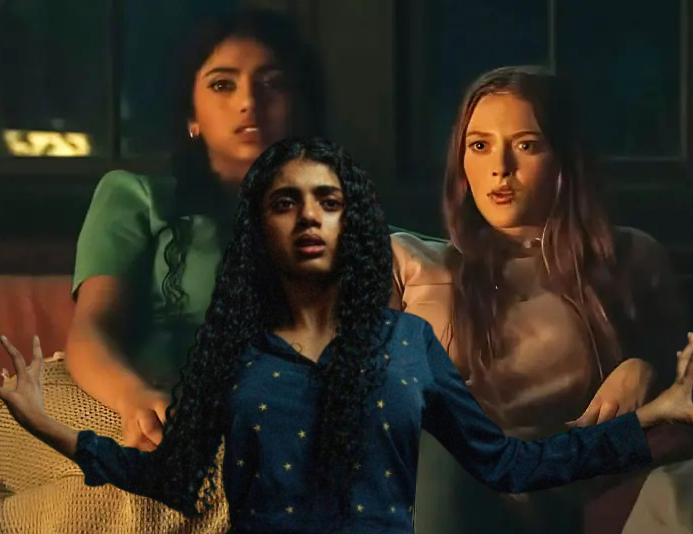
Horror films, as a genre, follow both spoken and unspoken rules. These rules often revolve around the “sins” of the characters, such as acting like a “whore” (mainly aimed at women), participating in substance abuse (such as marijuana and alcohol), or (as noted in Scream) “… Never, never ever under any circumstances do you ever say ‘I’ll be right back’ cause you won’t be back” (Jamie Kennedy as Randy Meeks). Usually, in these narratives, only the “pure” characters that stick to the status quo survive, falling into the category of “final girl” popularized by Carol Clover. Those who are sexually deviant, or practice “immoral” behaviors cannot be teh final girl, as they represent non0normativity. In addition to these rules, characters from minority backgrounds are often picked off first – leading to the saying “the Black guy dies first” (which is also the title of Mark H. Harris and Robin R. Means Coleman’s book discussing Black horror cinema). While this trope has been slowly going out of fashion, with movies such as Get Out (2017) and Sinners (2025) receiving high acclaim and notoriety, Hollywood has picked a new target. Tarot (2024) has a diverse cast, both in terms of race and sexuality, and allows some of the minority characters to survive the night. However, despite these characters surviving, the film gives the most gruesome, and violent deaths, to the lesbian couple. Of the five deaths featured in the film, theirs are the only two that are drawn out and feature the characters’ suffering as they die. While Tarot attempts to present a diverse cast, and gives ample screentime to this diversity, this is a false facade of diversity as it still targets a marginalized community; alligning itself with traditional tropes of horror that are sexist and homophobic.
From the beginning, the film attempts to bring light to its characters’ queer identities. The movie opens with a group of seven friends who are staying at an old mansion (which they booked through Airbnb) to celebrate the birthday of Elise. This party, organized by Elise’s girlfriend Paige, soon delves into chaos because they have run out of beer, leading to the discovery of the Tarot cards that will lead to their deaths. Their fortunes are read by the final girl Haley, who is currently on a break from her longtime boyfriend Grant. In the movie, characters are picked off in order of when their fortune was read and are killed by the character on their future card. As the friends are killed off, they eventually learn how to “beat” the Tarot deck and its owner “The Astrologer”, leading to a reconciliation of Haley and Grant.
The majority of the on-screen deaths in this film only offer brief glances of how the character passed, with more focus put into building the tension leading to their death or showing the aftermath of their passing. Lucas dies in a flash by a train running him over, Madeline is trapped in a noose and then pulled upward out of shot, and Alma is drawn into the darkness and then dropped in front of three survivors facedown with six swords in her back. Even the villain in the story gets a brief death, with the astrologer’s curse imploding into her, causing her to disappear. The shortness of these on screen deaths not only feel sudden to the viewers, especially since they are introduced by nail-biting tension, but also gives the characters a “quick” way out. Yes, they are scared by the fate that they cannot escape, but their actual deaths are not prolonged and often feel unfinished or rushed.
In contrast, Elise and Paige’s deaths are drawn out and their fear is fully shown to the viewer. In Elise’s case, which is also the first death in the movie, her head is bludgeoned repeatedly by a wooden ladder. The scene is fleshed out by the sound of her death echoing as blood and brain matter fly. Paige, for her demise, is trapped within a magician’s box as the character from the Magician card saws her body into pieces, slowly, as the viewers hear her cries of fear and the tearing of flesh. Her body, once it is separated, is then presented to a small crowd and the viewer leading to the most prolonged viewing of a character’s death in the film (Two minutes and fifteen seconds). Their deaths are not only gruesome when put into comparison with their costars but also showcase extreme violence towards these women. These two deaths are isolated from the rest of the killing spree and are obviously “different” than the deaths of their heterosexual counterparts. Their deaths are not only shocking but actively encourages the viewer to enjoy violence towards women who are not leading a secular life.
Lesbian-centered films are often absent in mainstream cinema, with only Bottoms being of note in recent years. While this film does somewhat center around lesbianism, the growth of the story is centered around the heterosexual couple and their reconciliation. Diana Fuss, in Inside/Out: Lesbian Theories, Gay Theories writes that, “… The current efforts in lesbian and gay theory…. have begun the difficult but urgent textual work necessary to call into question the stability and ineradicability of the hetero/homo hierarchy, suggesting that new (and old) sexual possibilities are no longer thinkable in terms of a simple inside/outside dialectic” (Fuss 1). The film tries to disrupt this hierarchy, as it attempts put hetero/homo relationships on an even footing by allowing both to play out on screen in front of the viewer. However, the film falls short of actually allowing both relationships to blossom and instead perpetuates this hierarchy by allowing the straight couple to survive as the lesbian couple are killed in garish manners.
Rather than actually representing minority characters or doing away with heteronormative tropes, the film instead falls into the pattern of its predecessors and exploits a marginalized community. While five of the twelve actors who worked on this film are People of Color, represented by three of the seven major characters (two of which survive the carnage), the violence towards the homosexual couple (half of which is of the racial minority) cannot be ignored. Rather than presenting a fully fleshed out cast of characters that face an issue together the film earmarks those who are the most “other” of the friend groups. Patricia White, also in Inside/Out, writes that:
... Lesbianism is... neatly assimilated to the "masculinization of the spectator position" as to constitute an impossible deviance. In asserting the female spectator's narcissistic over-identification with the image; in describing her masculinization by an active relation to the gaze; or in claiming that the fantasy of the film text allows the spectator to circulate among identifications "across" gender and sexuality, feminist film theory seems to enact what Freud poses as the very operation of paranoia: the defense against homosexuality. (White 146)
The lesbians in this movie are obviously in love, with Paige spending the majority of the film in mourning after Elise’s death, and because of this they are made to be an example of what will happen if one falls into “sexual deviancy.” Neither Elise or Paige would survive the film, given that they are straying away from inherent heterosexuality, but their deaths only encourage viewers to see them as a sideshow act by prolonging their deaths and suffering.
Tarot, while attempting to showcase queer identities in a positive light, ultimately falls into the tradition of targeting marginalized communities. Yes, there is strong representation of these communities – and even two thirds the survivors from the friend group are People of Color – but the film still targets queer identities and makes their deaths into grisly spectacles. While the lovers could have been killed and still have made the movie representative of the marginalized communities it sought to highlight, the fact that these deaths were so much more gruesome and unignorable erases the good the film could have done in the landscape of horror cinema.
Works Cited
Inside/Out : Lesbian Theories, Gay Theories, edited by Diana Fuss, Taylor & Francis Group, 1991. ProQuest Ebook Central, https://ebookcentral.proquest.com/lib/ksu/detail.action?docID=1144411.
Halberg, Anna and Spenser Cohen, directors. Tarot. Sony Pictures Releasing, 2024, Accessed 2 Feb. 2025.
 Girl and Sleuth
Leave a comment